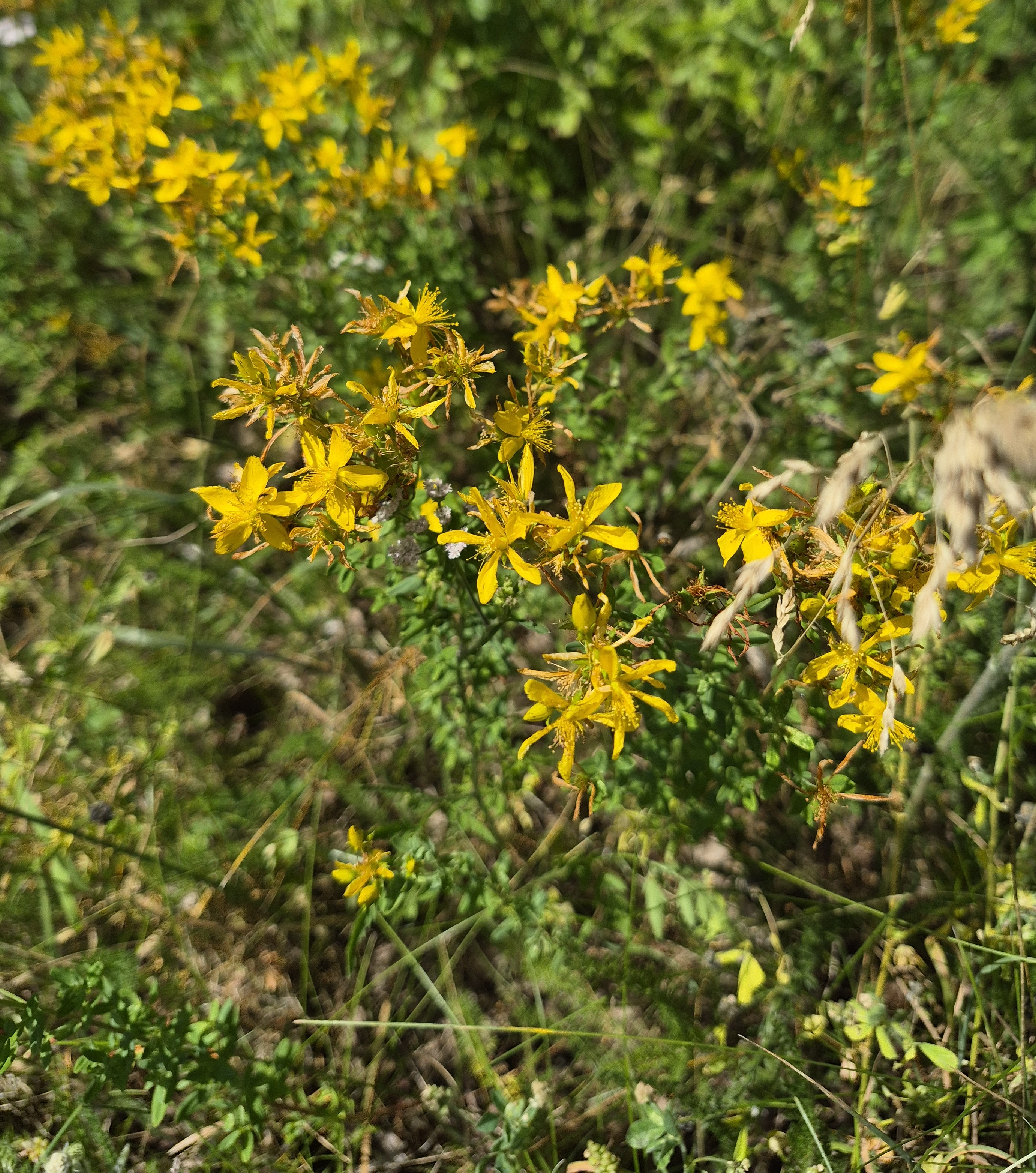
Flower Properties
| Property | Value |
|---|---|
| English Name | Common St. John's Wort |
| Scientific Name | Hypericum perforatum |
| MainColor | Yellow |
| PlantType |  Herb Herb |
| Distribution |  Native Native |
| Season Found | July (Jul - Non) |
| ImageUrl | Hypericum-003 |
| Photographer | DP |
| Location Found | Bedmond Lane WS |
| Country Found | UK |
| Photo Quality | A |
Flower Details
Description
St John's Wort is a perennial herb with bright yellow flowers that have five petals and are dotted with black glands. The leaves are oval and perforated with tiny translucent dots, which are visible when held up to the light. It typically blooms from June to September.
Distribution
It is native to Europe, but has widely naturalised in temperate regions across the world, including North America and Australia. It thrives in meadows, open woods, and along roadsides.
Medicinal/Other Uses

✅ St John's Wort is widely used for its antidepressant properties and is also applied to the skin for wounds and burns. It has been used in traditional medicine for centuries.
Edibility

Caution Advised - while not typically consumed as food, it is used in herbal teas and extracts.
Human Toxicity

Mildly_Toxic
Mildly Toxic - may cause photosensitivity, leading to skin irritation when exposed to sunlight. Interaction with certain medications can result in adverse effects.
Pet Toxicity

Highly Toxic to dogs and cats - ingestion can lead to increased photosensitivity and gastrointestinal upset.
Active Compounds
Hypericin, hyperforin, flavonoids