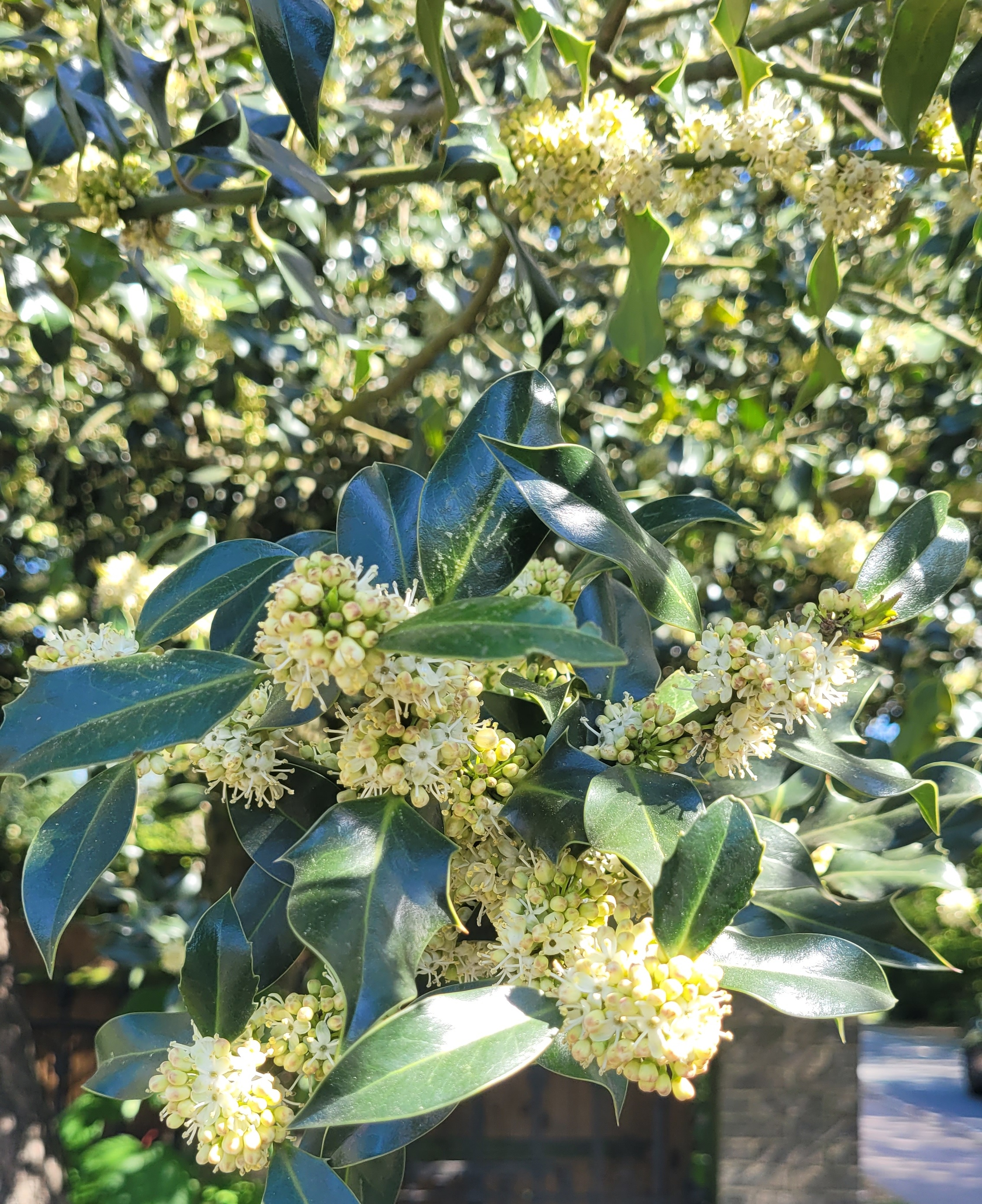
Flower Properties
| Property | Value |
|---|---|
| English Name | Common Holly |
| Scientific Name | Ilex aquifolium |
| MainColor | White |
| PlantType |  Tree Tree |
| Distribution |  Native Native |
| Season Found | March (May - Jun) |
| ImageUrl | Ilex-004 |
| Photographer | DP |
| Location Found | Abbots Langley |
| Country Found | UK |
| Last Updated | 06 September 2026 |
| Photo Quality | A |
Flower Details
Description
Holly is an evergreen shrub or small tree, notable for its glossy, spiny leaves and bright red berries. It can grow up to 15 metres tall and is often used as ornamental foliage, especially during the winter season.
Distribution
Native to western and southern Europe, northwest Africa, and southwest Asia, holly is commonly found in woodlands and hedgerows.
Medicinal/Other Uses

✅ Holly leaves have been used in traditional medicine to treat fever and rheumatism, though their effectiveness is not well-documented.
Edibility

Caution Advised - berries are mildly toxic and can cause vomiting and diarrhoea if ingested in large quantities.
Human Toxicity

Mildly_Toxic
Mildly Toxic - ingestion of berries can cause nausea, vomiting, and diarrhoea.
Pet Toxicity

Mildly Toxic to dogs and cats - ingestion of berries may lead to vomiting and diarrhoea.
Active Compounds
Caffeine, theobromine, saponins