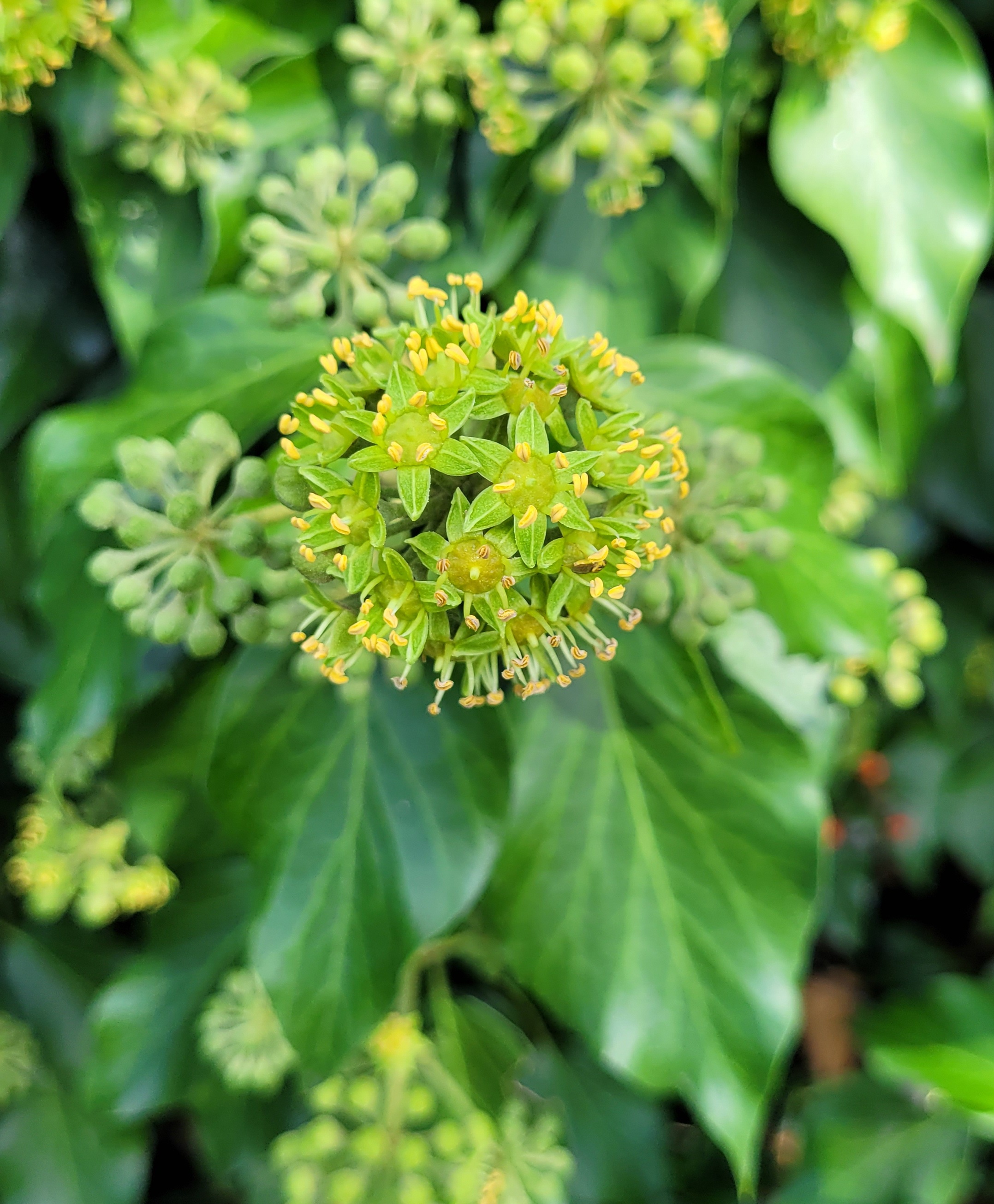
Flower Properties
| Property | Value |
|---|---|
| English Name | Common Ivy |
| Also Known As | English Ivy |
| Scientific Name | Hedera helix |
| MainColor | Green |
| PlantType |  Vine Vine |
| Distribution |  Native Native |
| Season Found | September (Sep - Nov) |
| ImageUrl | Hedera-001 |
| Photographer | DP |
| Location Found | Hemel Hempstead |
| Country Found | UK |
| Last Updated | 13 September 2026 |
| Photo Quality | B |
Flower Details
Description
English Ivy is a woody, evergreen vine that can climb up to 30 metres using aerial rootlets. Its leaves are dark green with white veins, and it produces small greenish-yellow flowers in late summer to early autumn.
Distribution
Native to Europe and Western Asia, English Ivy is widely distributed and naturalised in many parts of North America and Australia.
Medicinal/Other Uses

✅ Traditionally used in herbal medicine for respiratory conditions and as an anti-inflammatory agent.
Edibility
Caution Advised - berries are mildly toxic and should not be consumed.
Human Toxicity

Mildly_Toxic
Mildly Toxic - ingestion of leaves or berries may cause nausea, vomiting, and diarrhoea.
Pet Toxicity

Highly Toxic to dogs and cats - ingestion can cause vomiting, abdominal pain, hypersalivation, and diarrhoea.
Active Compounds
Hederin, hederacoside C, alpha-hederin.